
Backlash
Trump administration begins anti-environmental blitzkrieg
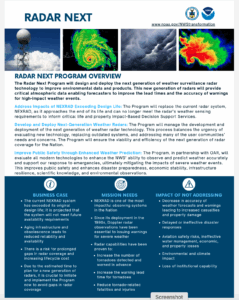 NOAA’s weather radar program was cancelled and information removed in Feb. 2025
Donald Trump takes office Jan 20, 2025 and immediately begins to dismantle environmental protections, climate science and renewable energy policies that had been put in place by previous Republican and Democratic administrations.
Jan. 20 — Trump declares a “National Energy Emergency“ claiming that the energy production capacity of the United States is “far too inadequate to meet our Nation’s needs.” This is caused by “the harmful and shortsighted policies of the previous administration.”
Critics such as Public Citizen note:
It may seem absurd that, at a time when no country in the history of the world produces more oil and natural gas every day than the United States, that there would somehow be an energy emergency. But when radical, unhinged fossil fuel executives have the ear of the President, they see this fraudulent emergency declaration as their opportunity to destroy progress of wind and solar development, and maximize fossil fuel exports that increasingly dictate whether their fracking operations are profitable or not.
Jan. 20 — Trump withdraws US from Paris Climate Accords claiming that such international agreements ” do not reflect our country’s values or our contributions to the pursuit of economic and environmental objectives.” Another executive order withdraws the US from the World Health Organization. which it claims “mishandled” the COVID pandemic.
February — Trump administration fires thousands of government staffers and scientists from EPA, NOAA, FEMA, the Dept. of Interior, the Dept. of Energy, the US Agency for International Development and the National Weather Service. The firings violate civil service rules and defy common sense. For example, US AID worked with global public health NGOs to monitor and fight contagious disease. No investigation into the pros and cons of the policies in place, nor any plan for new policies, is undertaken.
- The Trump administrations also administers a purging of federal information systems from any references to climate change or diversity and inclusion policies.
- The Trump administration also cancels billions in federal contracts designed to study public health and the environment.
- The Trump administration also attempts to cancel solar and wind projects nationwide, and orders the Dept. of Interior to defer to oil and gas development.
Feb 25 — The US Council on Environmental Quality, a White House agency, issues a final rule that removes regulations for implementing NEPA environmental reviews from the Code of Federal Regulations. While this doesn’t change the text of other laws, it alter the way environmental laws are enforced. (See this history of the CEQ by the Wildlife Society.)
March 2 — “In a few short weeks, President Trump has severely damaged the government’s ability to fight climate change, upending American environmental policy with moves that could have lasting implications for the country, and the planet,” says the New York Times “With a flurry of actions that have stretched the limits of presidential power, Mr. Trump has gutted federal climate efforts, rolled back regulations aimed at limiting pollution and given a major boost to the fossil fuel industry.”
March 7 – Scientists across America and Europe rally against destructive anti-science policies in Trump administration.
March 7 — The US Coast Guard Academy and other federal educational institutions are censoring climate science from the curriculum in a partisan effort to stifle climate science and understanding.
March 12 — Trump’s Environmental Protection Agency (EPA) announced 31 actions to revise pollution standards and study the benefits of climate change. EPA administrator Lee Zeldin says this is “driving a dagger straight into the heart of the climate change religion.” The Guardian newspaper says this day is just one example of Trump’s anti-environmental blitzkrieg.
March 20 — “Americans should not be conned by the Trump administration’s climate Lysenkoism,” say climate scientists Michael Mann and Bob Ward. ( Lysenkoism was a Stalin-era Soviet Union’s approach to politicized science that disrupted agriculture and led to mass starvation.).
March 20 — EPA staffers write open letter to the American public. “We cannot stand by and allow this to happen. We need to hold this administration accountable.”
April 8 — Trump says he will rescue the coal industry and signs a set of executive orders that he claims will clear away roadblocks to new power generation from coal. For a variety of economic and environmental reasons, no new coal fired power plant has come online since 2013, and there are no plans to build any now. In a news analysis, the Associated Press says that Trump is misrepresenting problems in the coal industry. like many of his policy initiatives, is based on ideology rather than science, economic logic or public health. In any event, it is misleading, says FactCheck.org, to claim that the coal industry’s problems come from environmental regulations.
April 11 — Trump orders an end to all climate science research at NOAA and NASA. The one exception would be research designed to show that a warming world will benefit humanity, which is a “highly misleading” claim that ignores “decades of scientific researching” showing climate change having dire effects. A BBC article explores Trump’s contradictory and confusing ideas on climate science.
April 18 — Trump administration begins cutting thousands of jobs at the US State Department. Among the first departments on the list: Human Rights.
April 22 — Trump administration abandons climate diplomacy and closes the office of the Special Presidential Envoy for Climate in the State Department.
May 1 — Trump has done more to attack environmental policy in his first 100 days in office than in his previous administration, according to the Guardian.
May 5 — Trump administration attempts to stop renewable energy projects.
May 8 — Pope Leo XIV installed as the new head of the Catholic Church following the death of Pope Francis April 21. Leo concern for the environment is similar to that of his predecessor. According to The Associated Press:
Pope Leo XIV (formerly Cardinal Robert Prevost) “deepened his ties with interfaith environmental networks like the Interfaith Rainforest Initiative and Indigenous organizations” which place “forest protection and rights at the center of Church concern.” He was also the president of the Pontifical Commission for Latin America, which connected him with neighboring countries that are also home to the Amazon.
And, according to Inside Climate News:
The new pope could guide the Catholic Church into a new era of care for the environment. Pope Leo XIV, once known as Robert Prevost, previously served as a bishop in Chiclayo, Peru, a city not far from the Amazon rainforest.
May 14 — Repeal of clean energy tax credits is part of sweeping new federal spending bill passed by Congress and signed into law in July.
May 21 — A hostile Senate Environment and Public Works Committee hearing exposes extreme animosity between pro- and anti-environmental factions in government. At one point, EPA administrator Lee Zeldin shouted at Sen. Sheldon Whitehouse (D-RI): “The American taxpayers, they put President Trump in office because of people like you.” US Senator Adam Schiff (D-CA) gave Zeldin a scorching rebuke in return. (See video this page)
July 4 — Over 100 people die in catastrophic flash flooding in central Texas after warnings are not relayed from the US National Weather Service (NWS) to local emergency managers. The immediate cause of the lapse is layoffs from the NWS as part of the Trump administration’s campaign against American science and technology. Experts warned in February 2025 that mass firings could endanger people. Meanwhile, the general cause of the flooding is the increase in weather disasters associated with a rapidly warming climate.
Trump assaults on environmental protection (summer 2025)
June 27 — Trump administration ends national forest protections for 58 million acres in the US, opening vast tracts of land to road building, logging, mining and development.
July 1 — Budget bill ends tax credits for wind and solar energy.
July 13 — Last of the US climate negotiators are fired from the State Department by the Trump administration as part of a general campaign to undermine American science and technology.
July 17 – Trump dismantles Chemical Safety Board despite industry support for the board.
July 17 – Trump closes the famed Mauna Loa observatory and other scientific research stations.
July 18 – Trump administration creates Interior Dept. rules designed to strangle wind, solar and other clean energy projects.
July 19 — US EPA eliminates research and development office.
July 23 — US EPA plans to eliminate the scientific endangerment finding that greenhouse-gas emissions threaten human life by dangerously warming the planet.
July 29 — US Department of Energy releases a report claiming that climate change is not a problem. Authored by fringe scientists, the report is immediately debunked by the scientific community. The last major national climate assessment of 2023 (before the Trump administration) concluded that fossil fuel – induced climate change was a very real threat. That report has been removed from government websites and is only available from the press and non-governmental organizations.
Oct 21 — Trump administration weakens toxic chemical safety rules.
Nov. 10 – 21 United Nations Climate Change Conference, held in Belem, Brazil, continues global discussions on the climate emergency but reaches no agreements on how to move forward. The United States government, for the first time in COP history, did not send representatives. In fact, the Trump administration took the occasion to announce new support for the fossil fuels. California Governor Gavin Newsom attended to promote his state’s environmental commitments and to form international partnerships.
Dec. 17 — Trump administration begins to dismantle the NCAR – National Center for Atmospheric Research. The move was blocked by a temporary restraining order June 2, 2026.
Dec. 24 — Trump orders halt to all US offshore wind projects due to unspecified (and probably imaginary) national security concerns. Lawsuits fighting this and previous attempts to derail renewable energy are filed by Virginia-based Dominion Energy and also a coalition representing regional wind and solar developers in a Massachusetts federal court.
2025 US environmental policy year in review:
New York Times: Trump’s administration has “dismantled a wide range of climate and pollution regulations, began to overhaul how the federal government responds to disasters and gave a boost to fossil fuel production and nuclear power while attempting to curtail the growth of wind and solar energy. The changes have reverberated far beyond the United States, as the administration has pressured other countries to abandon their own efforts to tackle global warming…”
Fox News: “Trump has signed a series of executive orders and legislation to scale back America’s green energy efforts. Now, a group of prominent conservative energy groups are declaring 2025 as the year of the cultural departure from climate activism. This year has proven to be an unexpected tipping point for climate realism…” Note the political use of the environmental science term “tipping point.” Previously, the term described the punctuated equilibrium of large environmental systems, such as global climate, and their reactions to the accumulation of small changes. See Malcolm Gladwell’s book by the same name.
Bulletin of the Atomic Scientists: The Trump administration came out swinging as soon as the president took office in January 2025, implementing a funding freeze that sent shockwaves through the scientific establishment. Climate scientist Adam Sobel issued a prescient warning in February that “the Trump administration could end a century of American scientific dominance.” Within weeks, thousands of datasets were removed from federal websites. Many valuable resources, like the Climate and Economic Justice Screening Tool, have disappeared from government websites, although volunteers have pooled their time, expertise, and resources to spin up unofficial versions.
Grist magazine: There’s a word for (Trump’s) reactionary response: greenlash, a social and political backlash against efforts to rein in emissions. In Trump’s second term, climate change has became a politically radioactive word: Phrases including “clean energy,” “climate science,” and “pollution” began disappearing from government websites. (The year featured)… an all-out assault on his predecessor’s policies, unraveling environmental protections and canceling climate research. Trump abandoned global climate commitments while aggressively promoting fossil fuels at home, even as the rest of the world installed more solar panels and wind turbines than ever before.”
2026
Feb 12 — Oblivious to climate science, the Trump administration rejects the 2009 Endangerment Finding under the Clean Air Act. The intended effect is to remove the federal government’s ability to regulate greenhouse gasses. Donald Trump claims, without evidence, that the tens of thousands of scientific studies about climate are a “scam.” The deeper context for this reckless conduct is an ideological war on behalf of fossil fuel producing companies and nations like Russia and Saudi Arabia against reasonable measures that might stave off rising greenhouse gas accumulation and related extreme climate events.
March 13 – Trump renews plans to shut down the National Center for Atmospheric Research because it is a source of “climate alarmism.” The move was blocked by a temporary restraining order June 2, 2026.
April 7 — Mexico is becoming a toxic sink as US environmental problems are increasingly offloaded to its southern neighbor, according to United Nations special rapporteur.
April 8 – EPA director Lee Zeldin celebrates climate denial at a Washington conference of the Heartland Institute. Claiming “vindication” for crackpot climate theories, Zeldin has “brazenly betrayed the agency’s core mission,” according to more than 160 environmental and public health organizations who have called for him to resign or be fired.
April 9 – Emperor penguins and Antarctic fur seals are listed as endangered on the International Union for the Conservation of Nature “Red List.”  Changes in sea-ice and reduced food availability have been devastating, especially for these Antarctic species, the IUCN said.
April 12 — Straight of Hormuz is blockaded as part of the Trump war on Iran. The move ramps up global tensions with no clear goal or rationale, but it does, at least, show the wisdom of abandoning fossil fuel energy in favor of clean renewable home-grown energy sources. As the months go by, the US blockade turns into a permanent stranglehold on the world oil economy.
April 21 — A win for solar — A federal judge blocks Trump administration attempts to stifle solar and wind power development.
April 25 — Trump fires every member of the U.S. National Science Foundation’s governing body.
April 27 — Trump cancels wind energy projects — The Trump administration will pay two energy companies $885 million to cancel offshore wind projects scheduled for California and the US east Coast. In exchange, the companies are said to have pledged to invest that money in oil and gas projects. The cancellations follow a March 22 billion-dollar payoff to Total Energies of France for cancelling another California project. New York Gov. Kathy Hochul criticized Trump for his “overt and never-ending hostility toward offshore wind that hurts our ability to meet our energy needs, create good jobs, and reach our state’s emission reduction targets.” The Trump rationale for the cancellations involves political perceptions rather than any serious economic or national security issues. It’s worth recalling that in 2020, 90 percent of Americans supported wind energy until the Trump administration began its anti-wind campaign.
May — Friction between the anti-environmental Trump administration and state governments heats up with the Trump Justice Department joining a lawsuit over climate change misrepresentations in Minnesota and its attempts to stop 165 wind power projects around the US, especially in California.
May 18 – Trump’s false claims about the climate – (NY Times) Renewable energy has helped make the worst-case scenario a bit less bad. The president said, falsely, it shows that climate scientists were wrong all along.
June 1 — Deep sea ocean monitoring network to be dismantled by Trump administration.
June 2 — All federal grants must be approved by Trump political appointees under a policy announced June 2.
June 2 – A federal judge blocked Trump administration plans to eliminate the National Center for Atmospheric Research.
Aug 2 — Extreme heat and drought in Europe has pushed the energy grid into a near-shutdown. For example, Hungary’s Paks nuclear power plant, which uses water from the Danube to cool its reactors, was producing only 240 megawatts of power rather than the usual 2,000 and planning for a complete shutdown.
Aug 3 – Anger over data centers is fueling a new political movement, according to Politico.
Aug 4 — (AP) Clean energy projects were improperly terminated by the Trump administration, a federal appeals court ruled.
Aug 5 — Trump’s push for AI Data Centers will come with at the cost of increased air pollution according to the New York Times. Enormous new gas-fired power plants with poor air pollution protection are being pushed through the permitting process in days rather than months.
Aug 6 — The Trump administration will pay a German firm $1.22 billion to give up its offshore wind leases and redirect development to fossil fuels.
Aug 7 — Fifty million people are likely to be pushed into acute hunger in the coming year because of the rapidly developing El Niño weather system, UN forecasters warn. Hundreds of millions more are already facing dangerous food insecurity.
The Trump war on science continues …
In the spring and summer of 2026, the Trump administration continued its race to undermine all American science and eliminate areas of research and grant-making that it did not understand. In one notorious example, funding for much-needed HIV/AIDs programs in the Gaza province of Mozambique was cut because the Trump administration thought the aid was going to the Gaza strip in the Middle East. The issue was further confounded when the Trump administration claimed that the program was distributing condoms to Middle Eastern Hamas militants and that they were using the condoms to build bombs. None of that was remotely true.
Using similarly flimsy pretexts the Trump administration has terminated thousands of grants, moved to control leftover funding through an overtly political process, dismissed expert advisory panels from the NAS and most other agencies, and started closing key federal climate and meteorological facilities. The closures and funding cuts were taking place without Congressional approval and with prejudice towards perceived “woke” research. Many of them have been opposed in court, but the effort has come close to breaking the mainspring of American science and innovation.
… and scientists are fighting back.
Fired NOAA employees have started their own database Climate.us, launched June 21, 2026. According to NPR, it fills a void left when a government-run climate information website was shut down last year by the Trump administration.