
 Wangari Maathai
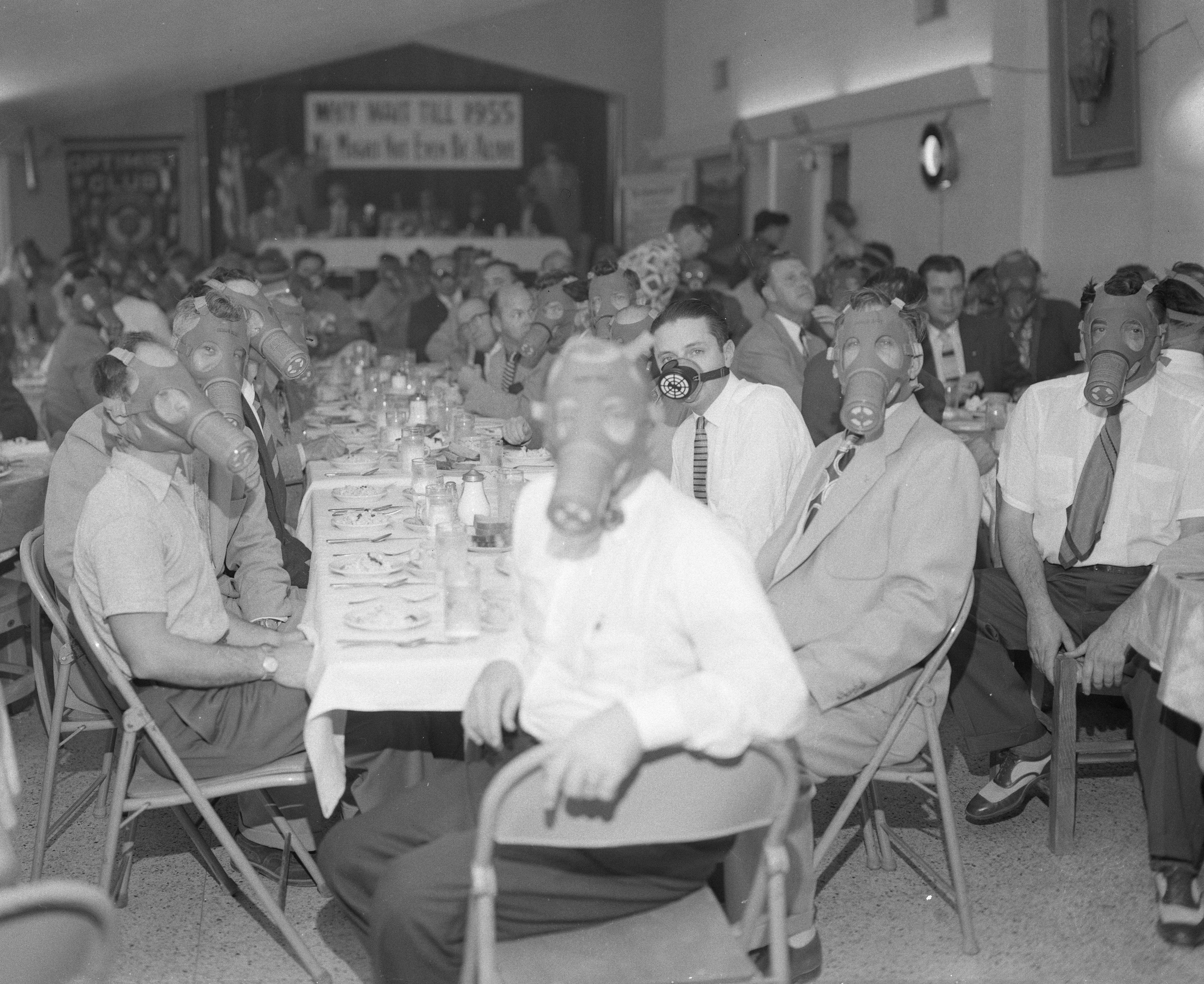 Smog Siege hits LA
 Resignation of James G. Watt
 End ocean dumping
 EH Updates
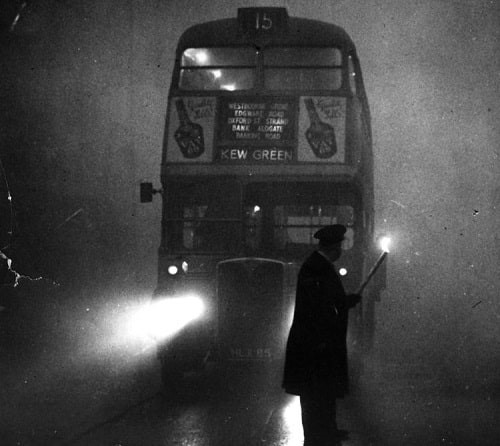
¶ London smog has been infamous for centuries, and when 4,000 people died in December 1952, the British government mocked worried meteorologists the same way that climate deniers mock scientists today. (In The Crown, Season 1 Episode 4, Churchill (played by John Lithgow) initially dismisses the gravity of the crisis, calling it an "act of God," while facing political pressure to resign.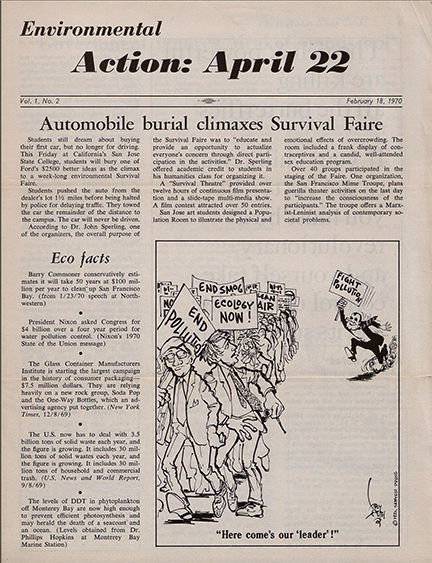 Environmental Action Archive
starting with Earth Day 1970 is now open at the University of Pittsburgh. The hats that created bird sanctuaries like the Mahleur Wildlife Preserve in Oregon in 1908 are featured in this OPB web site. The Mahleur has been the scene of a confrontation between right wingers and the federal government in January 2016.
 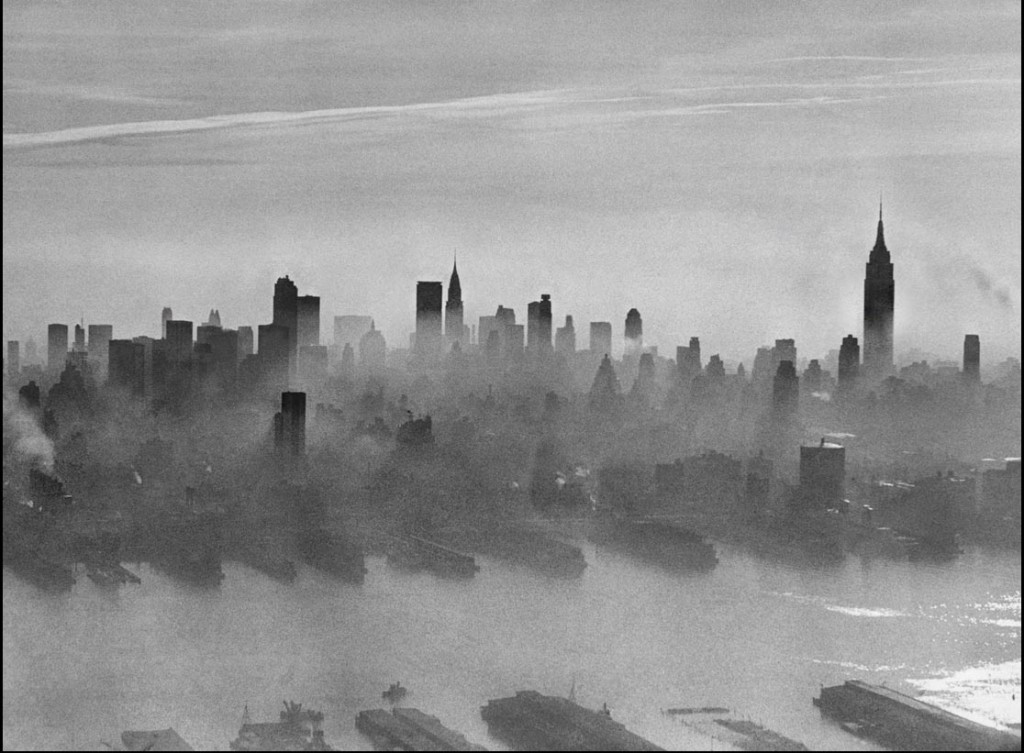 Pollution regs saved lives says Michael Greenstone in this Sept. 24, 2015 article in the New York Times. Although some people want to repeal the Clean Air Act, air quality regulations have averted tens of thousands of premature deaths, Greenstone says.
 ¶ A giant tree's death sparked the conservation movement in 1853. Terrific article by Leo Hickman of the Guardian on June 27, 2013. The "Mother of the Forest" was also covered in Neuzil and Kovarik's Mass Media and Environmental Conflict published in 1996.
  ¶ Dymaxion car Blueprints for the 1933 Dymaxion car designed by Buckminster Fuller showed up in a Massachusetts recently. The car was far ahead of its time but a fatal accident on a test site stalled development. Although widely celebrated for his innovative ideas, Fuller was not much of an automotive engineer, according to Smithsonian magazine.
 ¶ 1970 Clean Car Race is reported in MIT Technology Review in August, 2013. The cleanest car, among the electrics and hybrids, was a modified internal combustion engine.
¶ History of the Commons and today's environmental crisis is an excellent read in the May/June 2013 Utne Magazine.
¶ Saving the NJ Pine Barrens Writer John McPhee recalls the struggle to save a remnant of wilderness on the east coast. Philadelphia Inquirer, March 4, 2013.
¶ Remembering Darwin Scientific American remembers Charles Darwin and his impact on science on the 204th anniversary of his birthday, Feb. 12, 2012.
¶ Shackleton crew's 1916 ordeal -- a perilous journey taken after their ship got stuck and sank in Antarctica -- is being reinacted by a group of British and Australian adventurers. (Associated Press, Feb. 10, 2013)
¶ US air pollution was a lot like the pollution now in Beijing says Jim Bruggers of the Louisville Courier Journal and Alexis Madrigal in the Atlantic magazine in January 2013 articles. KCET public television also had a well illustrated article on L.A.'s smoggy past.
¶ First subway The London tube is 150 years old on Jan. 9, 2013. Mind the gap!
¶ Birth of the Clean Water Act Living on Earth interviews William Ruckelshaus, the first EPA administrator, about the Clean Water Act of 1972. "it was a terrible time," Ruckelshaus said. "I remember the first time I moved to Washington and the air was brown as I’d go to work in the morning. There was no industry in Washington at the time, that was all automobile pollution." Dec. 28, 2012.
¶ Remembering Barry Commoner A biologist and activist best known for studying baby’s teeth to demonstrate that radioactive fallout from atomic weapons testing was getting into our food supply and endangering our health. Living on Earth, Oct. 5, 2012.
¶ Bodega nuclear fight Gary Pace of Sebastopol, California reflects on the 1960s fight over building a nuclear power plant on top of the San Andreas earthquake fault at the Bodega Headlands. "I often wonder how (environmentalists) found the outrageous hope that they could halt the building of a nuclear plant once the work had started and I ask for similar inspiration." Living on Earth, Sept. 28, 2012.
¶ Climate change drove early human migration, anthropologists believe. NPR, Sept. 20, 2012.
¶ Ancient deforestation created the Danube River delta 8,000 years ago, scientists have found. Sept. 14, 2012New York Times.
¶ Environmental injustice The Hawks Nest Disaster of 1930 - 33 is getting a new memorial. In the infamous incident, between 700 to 3,000 US workers were killed or severely injured for life after boring a tunnel through a section of pure silica without then-standard respiratory protection. Sept. 7, 2012, W.V. Gazette. Also see this People's Press 1935 article about the disaster.
¶ National mammal? Teddy Roosevelt V argues that the US should remember its conservation history by making the bison the country's national mammal. Sept. 4, 2012
¶ Environmental Future Postcards from the past show the world of the future in 2012 in all its dazzling glory, from air police stopping traffic to whales pulling carriages full of divers. Fast Company, Aug. 20, 2012

¶ Smog of History LA Times recaps an article about testing pollution control devices in the 1950s. Aug. 17, 2012¶ Remembering the Radium Craze France's 19th century radium craze still haunts Paris, Reuters reports. "When the Franco-Polish Nobel Prize winner Marie Curie discovered the radioactive element radium in 1898, she set off a craze for the luminescent metal among Parisians, who started using it for everything from alarm clock dials to lipsticks and even water fountains." July 20, 2012
¶ Drought in ancient times The ancient Mayan water system was designed with drought in mind, as this New York Times article notes. Are there lessons for the modern era? July 17, 2012.
Category Archives: Environmental politics
VideoClimate denial is fraudulent, Senator says
Comments Off on Climate denial is fraudulent, Senator says
When coal smoke choked St. Louis in 1939
By Robert Wyss
The Conversation, CC, Oct. 21, 2025
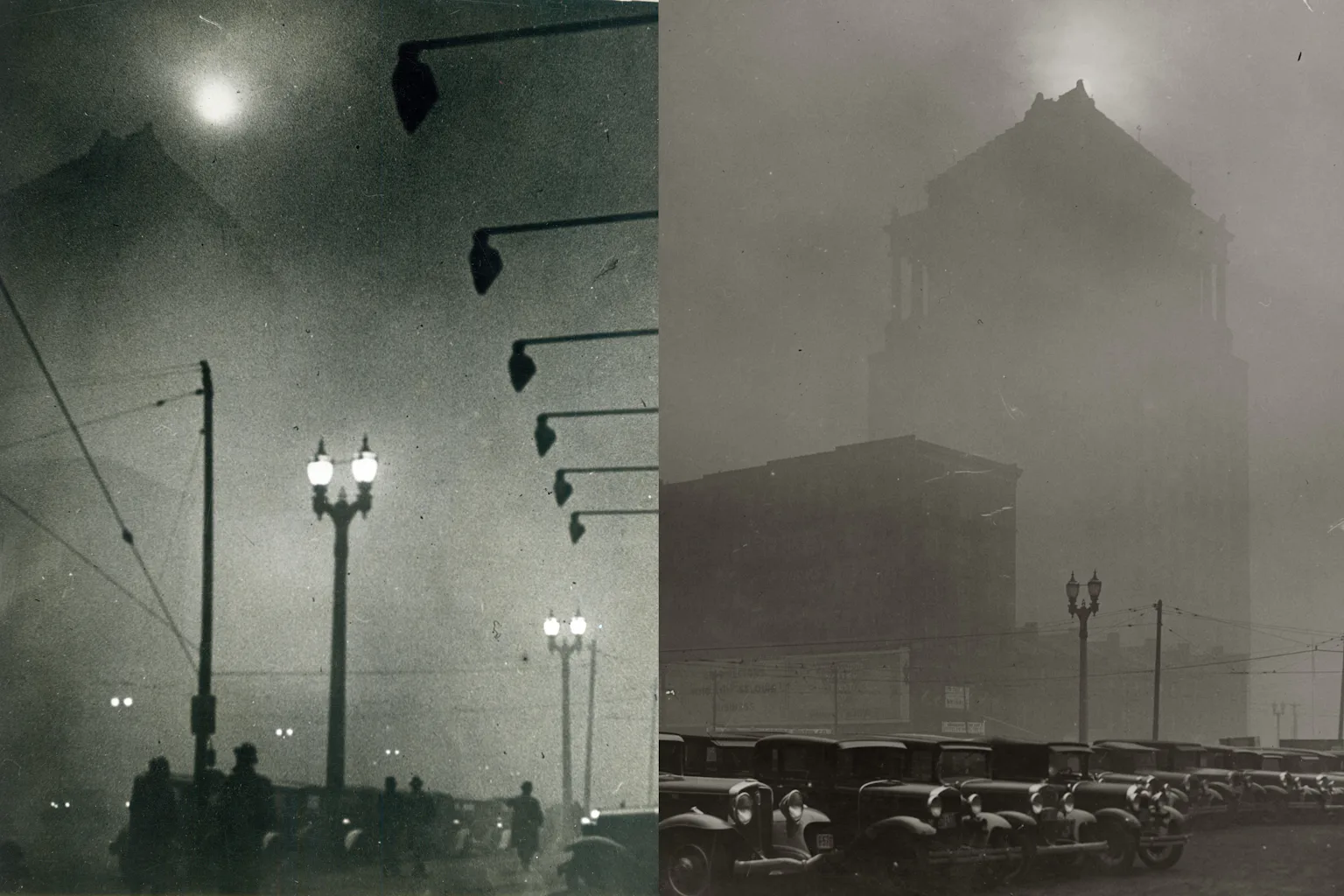
St. Louis on ‘Black Tuesday,’ Nov. 28, 1939. The smoke was so thick that streetlights were needed in the middle of the day.
It was a morning unlike anything St. Louis had ever seen.
Automobile traffic crawled as drivers struggled to peer through murky air. Buses, streetcars and trains ran an hour behind schedule. Downtown parking attendants used flashlights to guide vehicles into their lots. Streetlamps were ignited, and storefront windows blazed with light.
Residents called Nov. 28, 1939, “Black Tuesday.” Day turned to night as thick, acrid clouds blackened the sky. Even at street level, visibility was just a few feet. The air pollution was caused by homes, businesses and factories, which burned soft, sulfur-rich coal for heat and power. The soft coal was cheap and burned easily but produced vast amounts of smoke.
The murky morning was an extreme version of a problem St. Louis and dozens of other American cities had been experiencing for decades. Strict federal air pollution regulations were still 30 years away, and state and local efforts to limit coal smoke had failed miserably.
Today, as the Trump administration works to roll back air pollution limits on coal, the events in St. Louis more than 80 years ago serve as a reminder of how bad a situation can become before people’s objections finally force the government to act. And as I discuss in my book “Black Gold: The Rise, Reign and Fall of American Coal,” those events also highlight how successful that action can be.
The fight for cleaner air is a key part of St. Louis history. Days after Black
Comments Off on When coal smoke choked St. Louis in 1939
Posted in Climate, Environmental politics, Fossil fuels, People defending the earth
Last days of the Rainbow Warrior
Charleston, 1984. By Lin Burton.
Excellent new article in Slate Magazine by Dan Kios:
Four decades ago, a secret government team had a target—and a plan. It turned into one of the most sensationally botched crimes of the century.
Comments Off on Last days of the Rainbow Warrior
Posted in Environmental Ethics, Environmental politics, Humanities & environmental history, People defending the earth, Violence against advocates
Trump’s war on the environment
Defying US public opinion that has long favored climate action and environmental protection, Donald Trump, president in 2025, demonstrates how much damage one leader can do when motivated by the ideology of revenge. In only a few months in office, Trump has gutted scientific institutions of all kinds, from the Weather Service to the National Academy of Sciences; has started shutting down the Environmental Protection Agency, the Dept. of Interior, the National Park Service and many other federal institutions associated with conservation and the environment. He has also promoted fossil fuel use and undercut energy conservation programs. The sum of these and other damaging, dangerous and illogical policies is an historically unprecedented global policy crisis.
For Ongoing Updates:
-
- Associated Press climate and environment news
- Reuters environment and climate news
- New York Times: How Trump is crushing US climate policy
Comments Off on Trump’s war on the environment
Posted in Climate, current events, Environmental politics
Remembering Peter Dykstra
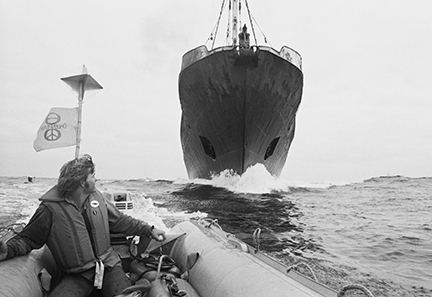
Greenpeace crew member Michael Baily blockades a Russian harpoon ship in a Zodiac. c. 1976. (Photo by Rex Weyler, courtesy of Greenpeace).
By Bill Kovarik
He was a Greenpeace spokesman, the CNN science unit producer, and publisher of Environmental Health News. Peter Dykstra covered a lot of ground in his 67 years. His death on July 31 in Atlanta, Ga. was a sad end to a life of joyful and spirited service to the environment.
I first met Peter Dykstra when the Rainbow Warrior came to visit Charleston SC in 1982. At the time I was privileged to work for the Charleston Post-Courier newspaper and was assigned to the environment beat.
The Charleston paper was known at the time for its ultra-conservative editors, and when the Rainbow Warrior docked in town, I was told not to write about the “hippies of the sea,” as they called Greenpeace.
This seemed unfair. Other coastal US cities like Baltimore and Wilmington were rolling out the red carpet for the Rainbow Warrior. So when Greenpeace media director Peter Dykstra called me on the phone to ask about our coverage, I told him the situation, and he came up with a clever solution.
Comments Off on Remembering Peter Dykstra
Posted in about history, Environmental justice, Environmental politics, People defending the earth
Stop the slaughter

Berta Cáceres, Honduran activist killed in 2016. (Photo courtesy Goldman Environmental Prize).
As the year 2020 closes, two more environmental activists are gunned down in Honduras. Although it’s outrageous, it’s also business as usual for timber thieves, hydro dam builders, and owners of mining projects.
Honduran authorities say they are investigating, but not much is expected. Following the 2016 murder of Berta Caceres in Honduras, the government arrested eight men linked to right wing military death squads, but in 2018, the courts suspended their trial.
Global human rights and environmental organizations are deeply appalled and outraged at the ongoing slaughter of environmental leaders and the journalists who cover their concerns.
One response has been the Regional Agreement on Access to Information, Public Participation and Justice in Environmental Matters in Latin America and the Caribbean – known as the Escazú Agreement. The treaty “aims to combat inequality and discrimination and to guarantee the rights of every person to a healthy environment and to sustainable development”.
But even Chile, where the agreement was first conceived, finds the agreement “inconvenient.”
This is an international human rights issue and, in our view, the Biden Administration should lead a global investigation, The call to conscience cannot be ignored.
For as full a list as we can make, of names of those murdered while defending the environment, see the page on this Environmental History Timeline.
And in the first few weeks of 2021, another seven names are added to the list.
Comments Off on Stop the slaughter
Posted in Environmental justice, Environmental politics
Joe Biden’s environmental challenge
Joe Biden’s victory in the US 2020 presidential race portends a full 180 degree turn in environmental policy. The campaign has consistently called climate change the “number one issue facing humanity” and the Biden administration has vowed a national transition from fossil fuels to renewable energy.
Among the environmental initiatives Biden promised in the campaign:
- Put into place a $2 trillion plan for infrastructure towards a goal of zero carbon pollution from electricity by 2035 and net-zero emissions by 2050, the campaign said.
- Establish an Environmental and Climate Justice Division within the U.S. Department of Justice.
- End fossil fuel subsidies
- Rejoin the Paris Climate Accords
- Reverse Trump climate and environment policy rollbacks in EPA, Dept. of Energy, Interior, Defense and other agencies.
- Take a science-based approach to air, water, chemical and solid waste pollution through the Environmental Protection Agency
- Return to fuel efficiency standards for new cars and light trucks
- Establish an Office of Climate Change and Health Equity at HHS and Launch an Infectious Disease Defense Initiative.
“The first 100 days of the Biden administration are likely to see a flurry of executive actions addressing climate change, as well as a major push to insert clean energy provisions into legislation that could pass with a bipartisan coalition,” says Lisa Friedman of the New York Times.
Comments Off on Joe Biden’s environmental challenge
Posted in Environmental justice, Environmental politics
Pope Francis’ long-awaited climate encyclical
June 18, 2015 — ROME — Pope Francis has issued an extraordinary environmental statement calling for environmental justice between the generations and dialogue in the international community. In one portion he says: 165. We know that technology based on the use of highly polluting fossil fuels – especially coal, but also oil and, to a lesser degree, gas – needs to be progressively replaced without delay.
The full statement is found at a Vatican website here. The statement begins: ——————
“LAUDATO SI’, mi’ Signore” – “Praise be to you, my Lord”. In the words of this beautiful canticle, Saint Francis of Assisi reminds us that our common home is like a sister with whom we share our life and a beautiful mother who opens her arms to embrace us. “Praise be to you, my Lord, through our Sister, Mother Earth, who sustains and governs us, and who produces various fruit with coloured flowers and herbs. ”(#1 Cantico delle creature: Fonti Francescane (FF) 263. )

St. Francis
2. This sister now cries out to us because of the harm we have inflicted on her by our irresponsible use and abuse of the goods with which God has endowed her. We have come to see ourselves as her lords and masters, entitled to plunder her at will. The violence present in our hearts, wounded by sin, is also reflected in the symptoms of sickness evident in the soil, in the water, in the air and in all forms of life. This is why the earth herself, burdened and laid waste, is among the most abandoned and maltreated of our poor; she “groans in travail” (Rom 8:22). We have forgotten that we ourselves are dust of the earth (cf. Gen 2:7); our very bodies are made up of her elements, we breathe her air and we receive life and refreshment from her waters…
Comments Off on Pope Francis’ long-awaited climate encyclical
Posted in current events, Environmental justice, Environmental politics, Humanities & environmental history
Environment used to be bipartisan
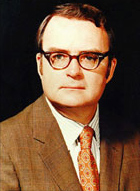 Environmental protection had enormous bipartisan support in the US during the 1970s, says former EPA administrator William Ruckelhaus in a February 2015 interview with the Public Integrity Project. Has that support changed? “Oh, yes, quite a bit,” Ruckelshaus says. “The Reagan Administration was less sympathetic than the Nixon Administration to environmental regulation, environmental laws, but nowhere near where the Republican Party has come today.”
Comments Off on Environment used to be bipartisan
Posted in Environmental politics
Soft soap and fracking dangers
 Some day soon, an oil & gas industry representative will probably tell a journalist, or a politician, or a concerned parent: “Fracking water is as safe as dish soap. Check out the 2014 University of Colorado study.”
And of course that will be horribly wrong, but very few people will know why.
This is particularly important in light of New York governor Andrew Cuomo’s announcement that a state health department study found that fracking is too dangerous for New York state (as reported in the NY Times Dec. 17, 2014.)
At best, people will chalk the difference up to the old adage: For every PhD, there is an equal and opposite PhD. But nothing could be further from the truth.
Comments Off on Soft soap and fracking dangers
Posted in about history, Environmental justice, Environmental politics